 PURESINE
Tone lists & categories
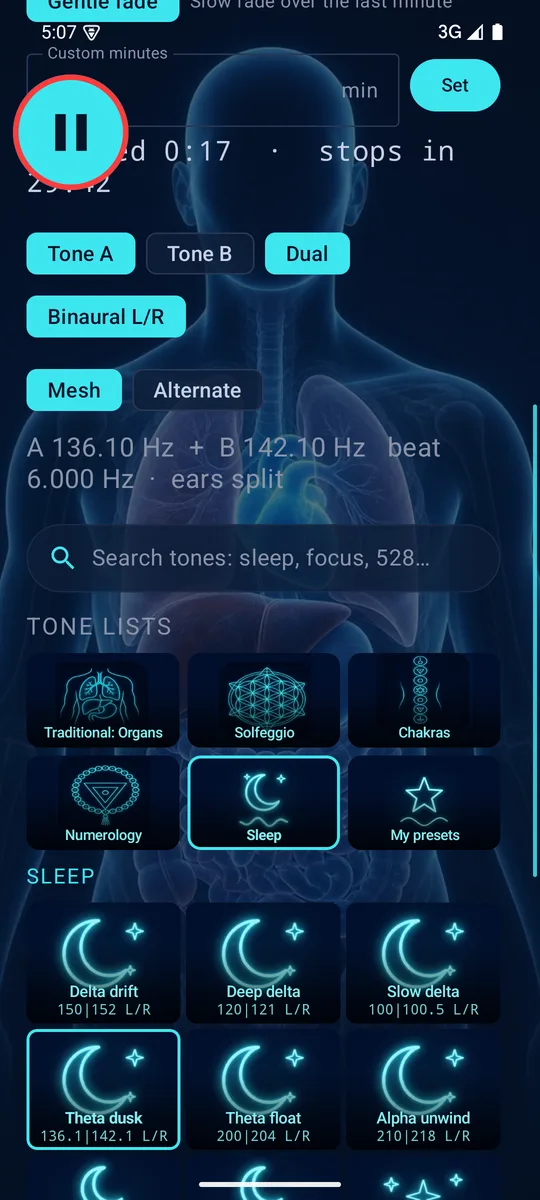
Glowing tiles organize curated lists, each with notes on how the tones are traditionally associated.
- Sleep
- Solfeggio
- Chakras
- Numerology
- Traditional: Organs
- My presets
 PureSine – sleep tones, binaural beats and 432 Hz for Android
Pure tones for sleep, focus and calm. Tuned by you.
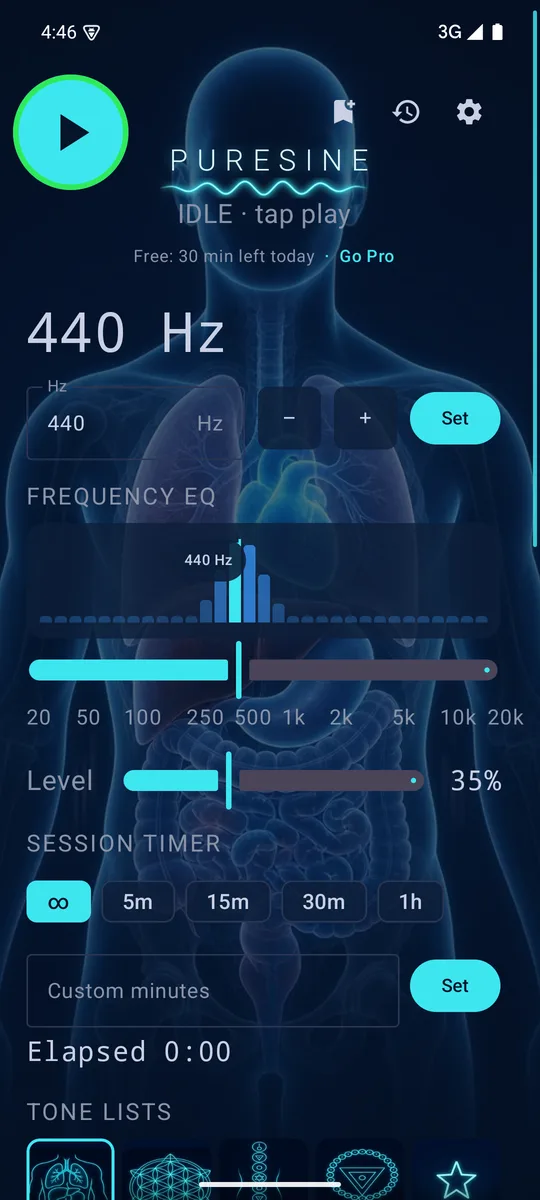
A beautifully simple frequency generator for Android. Play sleep tones, binaural beats, 432 Hz and solfeggio frequencies, or dial in any tone you like. Everything runs on your phone, offline.
Free to try · Optional one-time Pro unlock · No ads, no accounts
Features
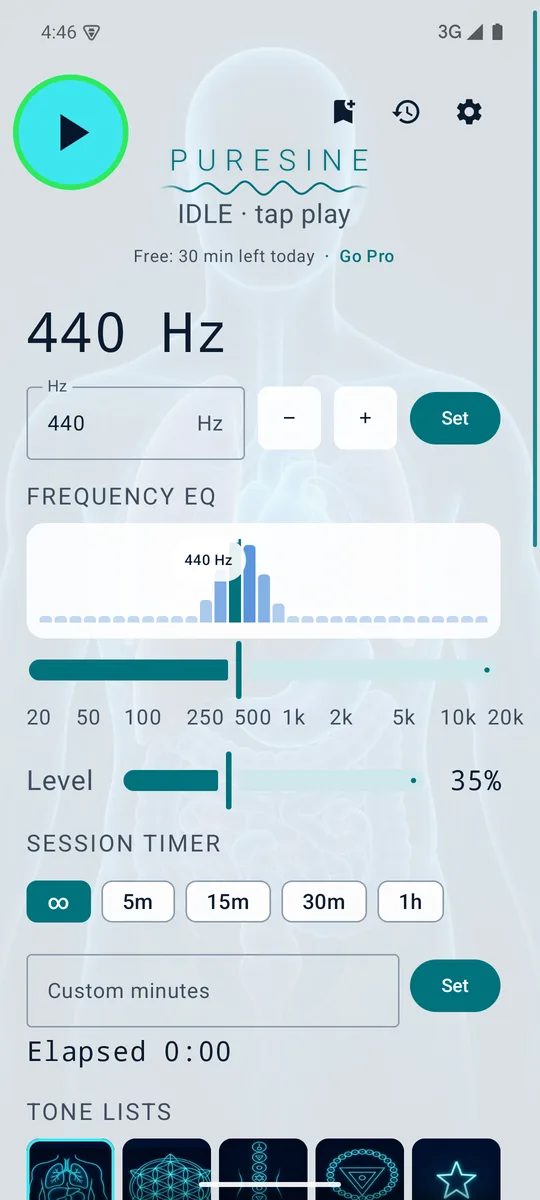
From meditation tones to relaxing sounds for sleep, PureSine keeps it calm: one screen, glowing controls and nothing you don't need.
Glowing tiles organize curated lists, each with notes on how the tones are traditionally associated.
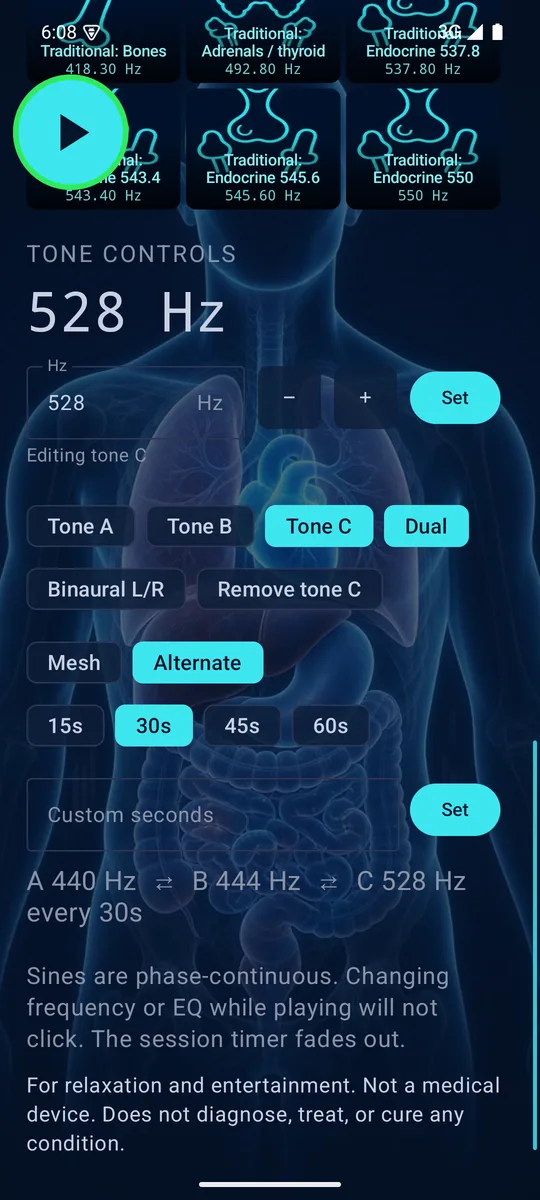
Layer tones A, B and C together in Mesh, or cycle through them in Alternate with a switch time you choose.
Send a slightly different tone to each ear for classic binaural beats. Headphones required.
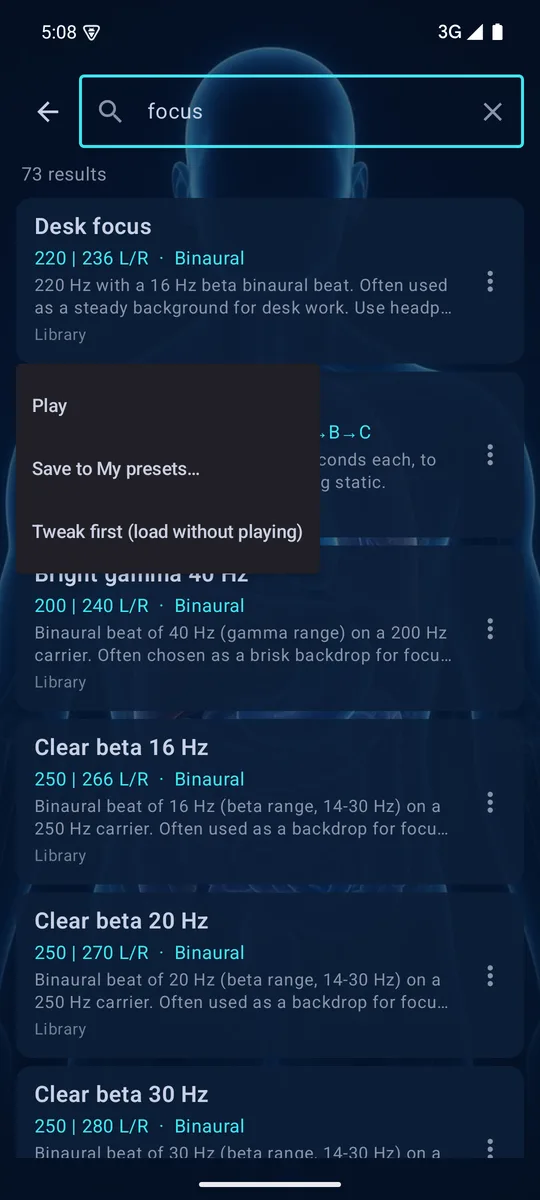
Type what you're after, like "sleep", "focus" or "relax", and search a built-in library of about 300 tagged tones and binaural combinations.
Save any setup, star favorites, or build a custom tone with your own name, frequencies and mode.
Pick ∞, 5m, 15m, 30m, 1h or 90m, or type your own. Gentle fade eases the tone out at the end.
Play, pause and stop from the lock screen or notification, and start your last tone from a Quick Settings tile.
Deep navy for night, a clean teal light theme for day, or follow your system setting.
Dial in any tone up to 20 kHz with a live frequency EQ. Smart output tips help on phone speakers and Bluetooth.
Free vs Pro
No subscription, no ads. Try everything, and unlock unlimited listening only if you love it.
$0
$4.99 one-time
Pro is a one-time in-app purchase through Google Play. Price is planned and may change before launch; Google Play sets local prices in other countries.
History & culture
The tones in PureSine come from very different places: medieval singing lessons, 19th-century acoustics, orchestra tuning debates and modern meditation practice. Here's where each one comes from.
The Italian music teacher Guido of Arezzo helped singers learn melodies by naming six notes after the first syllable of each line of the Latin hymn Ut queant laxis: ut, re, mi, fa, sol, la. "Ut" later became "do." The syllables named steps of a scale, not fixed pitches, since there was no way to measure pitch in hertz yet.
The Prussian physicist Heinrich Wilhelm Dove noticed that two slightly different tones, one played to each ear, are heard as a slow pulsing "beat" that exists only in the listener's perception. For over a century it stayed a scientific curiosity.
Orchestras across Europe tuned to different pitches. In 1859 France fixed its diapason normal at A = 435 Hz, and a conference in Vienna endorsed it in 1885.
Following the advice of composer Giuseppe Verdi, an Italian congress of musicians adopted A = 432 Hz, arguing that a lower pitch was friendlier to singers' voices. The French 435 Hz standard soon won out across Europe.
The seven-centre chakra system familiar in the West grew out of older Indian yoga traditions as they were reinterpreted by Theosophical writers, notably C. W. Leadbeater's The Chakras (1927). Pairing each chakra with a particular tone is a later practice of modern sound and meditation circles, and different teachers use different maps.
An international conference in London in 1939 recommended A = 440 Hz as concert pitch. The International Organization for Standardization adopted it in 1955 and reaffirmed it as ISO 16 in 1975. Some musicians still prefer 432 Hz, and it remains popular in ambient and meditation music.
Gerald Oster, a biophysicist at Mount Sinai School of Medicine in New York, published "Auditory Beats in the Brain" in Scientific American. The article gathered more than a century of research and described binaural beats as a tool for studying how the brain processes sound.
The list of "solfeggio frequencies" seen online today (174 to 963 Hz) is not medieval. It traces to Joseph Puleo, who is said to have worked out the numbers from verse numbering in the biblical Book of Numbers, and was popularized in a 1999 book he co-wrote with Leonard Horowitz. More tones were added to the list later. They borrow Guido's syllable names but have no documented link to medieval music.
PureSine lets you explore all of these as sound. Each built-in tone describes what it is "traditionally associated with" in meditation practice and popular culture, and you're free to make your own.
Learn
Short, plain-English guides to binaural beats, solfeggio frequencies, 432 Hz and more.
FAQ
Only for binaural beats, which need a separate tone in each ear. Everything else plays on your phone speaker or a Bluetooth speaker. Low tones under about 250 Hz are faint on most phone speakers, so PureSine shows a quick tip when headphones or a speaker would sound better.
Yes. Every tone is generated live on your phone and the whole tone library is built in. An internet connection is only needed when Google Play processes a purchase or restore.
Yes. Pro is a single in-app purchase through Google Play with no subscription. The planned price is $4.99 in the US.
Sign in to Google Play with the same Google account, then open Settings › PureSine Pro and tap Restore.
No. There are no accounts, ads or analytics. Your presets, history and settings stay on your device. See the Privacy Policy.
No. PureSine is a wellness and lifestyle app: For relaxation and entertainment. Not a medical device. Does not diagnose, treat, or cure any condition.